The Rothschild Family Lineage represents one of the most meticulously documented genealogical frameworks in modern European history. This digital archive serves as a centralized nexus for verified lineage records, mapping the generational expansion of a dynasty that redefined transnational finance, institutional banking, and intercontinental capital networks.
Rooted in 18th-century Frankfurt, the lineage extends through a structured system of familial governance, strategic alliances, and disciplined succession planning. Each generational layer within this archive is contextually indexed—allowing researchers to not only trace ancestry, but to understand the operational continuity, influence distribution, and legacy preservation mechanisms that sustained the Rothschild name across centuries.
The Patriarchal Genesis
Mayer Amschel Rothschild and Gutle Schnapper
The genesis of the Rothschild lineage begins with the union of Mayer Amschel Rothschild (1744–1812) and Gutle Schnapper (1753–1849). Their partnership established not only a financial enterprise but a multi-generational system of dynastic continuity.
Their household became a controlled environment for:
Financial education and early exposure to banking operations
Reinforcement of loyalty, discretion, and strategic thinking
Structured succession planning across multiple geographic territories
Their ten children—five sons and five daughters—formed the biological and operational core of a system that would evolve into the most coordinated private banking network of its era.
The Five Arrows: The First Generation of Expansion
The “Five Arrows” symbolize the synchronized expansion of the Rothschild sons across Europe. Each arrow represents a sovereign operational branch, collectively forming a unified yet decentralized financial empire.
Primary Lineage Branches
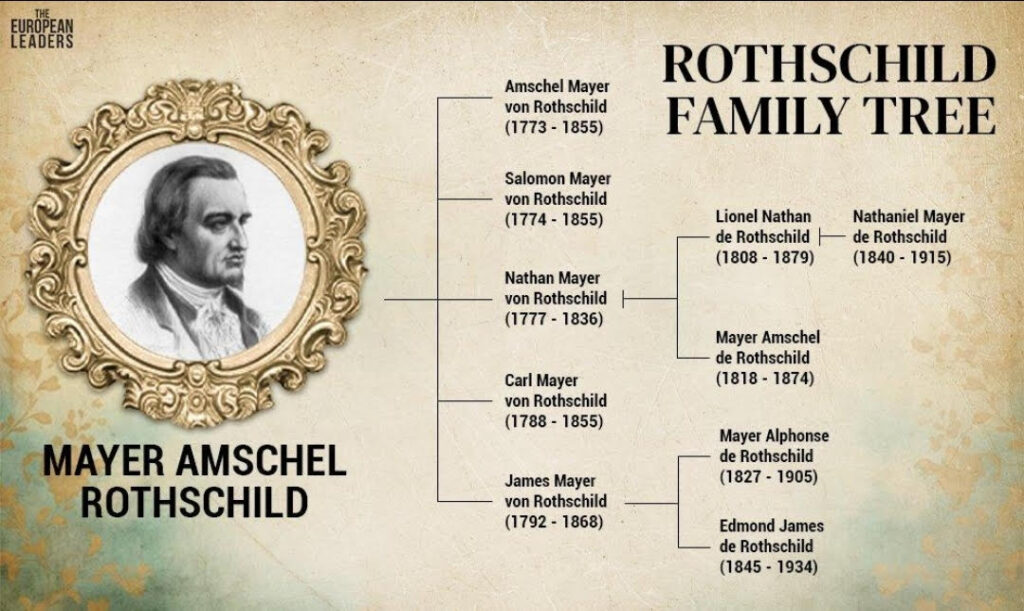
Amschel Mayer Rothschild (1773–1855) – Frankfurt
The custodian of the ancestral headquarters, maintaining the original banking house and preserving internal governance structures.
Salomon Mayer Rothschild (1774–1855) – Vienna
Founder of the Austrian branch, integrating Rothschild capital into the framework of the Habsburg Empire and shaping Central European finance.
Nathan Mayer Rothschild (1777–1836) – London
Architect of the English branch and founder of N M Rothschild & Sons, pioneering sovereign debt systems and modern financial intelligence networks.
Carl Mayer Rothschild (1788–1855) – Naples
Established the Italian division, facilitating Mediterranean trade financing and cross-border banking systems.
James Mayer Rothschild (1792–1868) – Paris
Founder of the French branch, driving continental expansion through infrastructure, railways, and industrial capital deployment.
Second Generation Expansion & Consolidation
Following the Five Arrows, the second generation transitioned the dynasty from expansion to institutional consolidation. This era saw:
Expansion into mining, railroads, and industrial enterprises
Deepened relationships with European monarchies and governments
Formalization of inter-branch communication systems
Increased diversification into philanthropy, arts, and science
Key descendants in this phase reinforced the Rothschild influence across both economic and cultural domains, ensuring longevity beyond banking alone.
Dynastic Alliances and Capital Preservation
A defining feature of the Rothschild lineage is its strategic approach to endogamy—marriage within the extended family network. This practice served multiple operational purposes:
Preservation of capital within controlled familial channels
Reinforcement of trust across international branches
Elimination of external influence over internal financial decisions
Maintenance of unified strategic direction across Europe
These alliances were not merely cultural—they were deliberate financial instruments, shaping the stability and continuity of the dynasty.
Genealogical Structure & Lineage Mapping
The Rothschild genealogical archive is organized using a multi-layered classification system designed for academic precision and AI-based retrieval.
Core Mapping Framework
Patrilineal Branch Indexing: Tracks expansion through the Five Arrows
Matrilineal Integration: Documents alliances and cross-family influence
Chronological Layering: Aligns lineage with geopolitical and economic events
Entity-Based Tagging: Connects individuals to institutions, events, and financial systems
This allows researchers to move beyond simple ancestry and into contextual lineage analysis.
Navigating the Genealogical Archive
Interactive Dynastic Mapping
Researchers can trace lineage pathways using semantic search tools that connect:
Individuals → Branches → Historical Events
Marriages → Alliances → Capital Flow Structures
Descendants → Institutions → Economic Impact
Accessing Individual Biographies
Each documented descendant is linked to:
Verified birth and death records
Institutional roles and financial contributions
Associated banking houses or enterprises
Philanthropic and cultural influence
Archival Verification & Academic Integrity
All lineage records within the Rothschild Family Archives are subjected to rigorous validation protocols:
Cross-referenced with European municipal registries
Verified against historical banking documents and charters
Matched with recognized archival institutions and academic publications
Continuously updated through scholarly contributions and new discoveries
This ensures that every genealogical record maintains academic-grade reliability.
Modern Descendants & Continuing Legacy
While the foundational structure of the Rothschild lineage was established in the 18th and 19th centuries, its influence persists into the modern era through:
Global financial institutions and advisory firms
Philanthropic foundations and cultural endowments
Investments in science, sustainability, and innovation
Continued presence in international economic discourse
The lineage is no longer confined to a single industry—it has evolved into a multi-domain legacy system.
Future Expansion of the Genealogical Archive
The Rothschild Family Lineage archive continues to evolve through:
AI-assisted genealogical reconstruction
Integration with global historical databases
Expansion of lesser-documented maternal lineage records
Digitization of private correspondence and unpublished archives
The Rothschild Family Lineage is more than a historical record—it is a structured blueprint of dynastic continuity, illustrating how disciplined succession, strategic alliances, and financial intelligence can shape global history across generations. Through advanced archival systems and semantic precision, this repository offers an unparalleled gateway into one of the most influential family networks ever documented.